“I worked hard, so I deserve a treat.” There is nothing wrong with wanting a reward, or with buying something you enjoy. The habit becomes less useful when shopping is the automatic reward for finishing work, getting through stress or escaping boredom—and an unplanned purchase becomes the only way to feel better.
The aim is not necessarily to stop shopping. It is to separate the feeling you want from the act of spending, so you can make a purchase deliberately rather than reaching for it by default. That starts with noticing what tends to happen just before you buy, then giving yourself another way to celebrate, rest or change your mood. Discounts can add urgency to that reward, so notice when an item being on sale becomes the main reason to buy it.
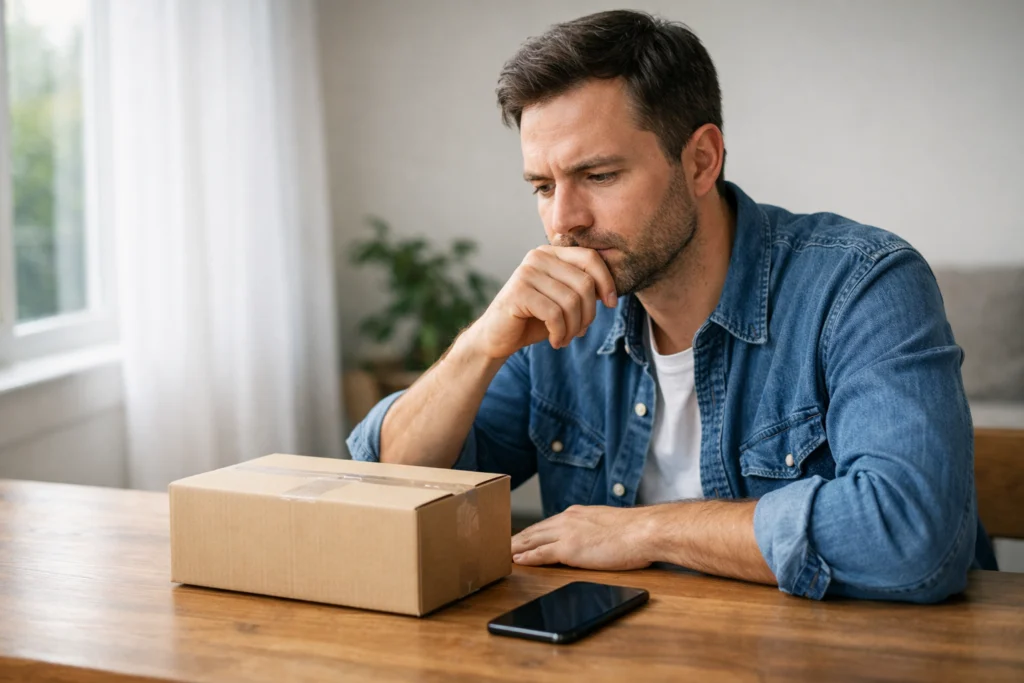
Notice what the purchase is doing for you
A purchase can offer a brief lift, mark the end of a demanding task, provide something to look forward to or distract you from an uncomfortable moment. The same person may shop for different reasons at different times. A treat after a success is not necessarily the same as scrolling through a shopping app because you feel lonely or restless.
Research reviews describe shopping as serving short-term emotional functions, including mood regulation. That does not mean every enjoyable purchase is a problem, or that emotions are the sole reason people buy things. It does suggest that it can be useful to ask what you hope a purchase will provide in that particular moment.
For a few days, make a simple note when you feel the urge to buy. You do not need to track every purchase or turn this into a detailed budget exercise. Record four things:
- What was happening just before the urge?
- What were you feeling—tired, excited, stressed, bored, disappointed?
- Was the item already planned, or did it appear in the moment?
- How did you feel later, after buying or deciding not to buy?
Keep the notes neutral. “Ordered shoes after a difficult call; felt excited at first, then worried about the cost” tells you more than “I was stupid.” The point is to spot a pattern, not to judge yourself. You might find that shopping mostly follows a particular kind of workday, a late-night scrolling session or an achievement you do not otherwise take time to acknowledge.
Separate the need for a reward from the item
When the urge arrives, try naming the reward you want before deciding what to do. Are you looking for celebration, comfort, stimulation, rest or a sense that your effort counted? These needs can be real even when buying something is not the only—or most helpful—way to meet them.
A small pause creates room to answer that question. It does not need to be a strict waiting period or a test of willpower. You could close the shopping page, put the item on a list, take a short break and return to the decision when you are less caught up in the moment. Choose a pause that feels realistic; a fixed number of hours or days is not a guaranteed solution.
Then ask: Would I still want this if I were not trying to change how I feel right now? If the answer is yes, that does not automatically mean you should buy it. Consider whether it fits your plans and budget, and whether you would choose it at another time. If the answer is no, the urge may be pointing to a need the item cannot meet for long.
It can also help to make planned spending easier to distinguish from reactive spending. Keep a wish list for things you may want, and revisit it when you are not actively shopping. An item can stay on the list without becoming an obligation to buy it. If it still seems worthwhile later and fits your spending plans, you can choose it deliberately.
Choose a reward that matches the feeling
A substitute works best when it addresses the reason you wanted to shop. “Do something else” is too vague when you are tired or upset. Instead, prepare a few simple options in advance, so you are not trying to invent one while the urge is strong.
- If you want to celebrate: share the news with someone, make a favourite meal, or set aside time for an activity you enjoy.
- If you want comfort: take a shower, make a warm drink, rest without your phone or call someone you trust.
- If you feel bored or restless: choose a specific activity, such as cooking, reading, going for a walk or meeting someone.
- If you need a break: step away from the task, stretch or spend a few minutes outside before deciding what to do next.
These are examples, not prescriptions. A walk may help with restlessness but feel like another demand when you are exhausted. A call may feel supportive to one person and draining to another. Choose options that genuinely appeal to you and are practical in your circumstances.
Some rewards can involve spending, provided spending is not doing all the work. A planned coffee with a friend or a modest treat you have included in your budget is different from automatically ordering something whenever you feel depleted. The useful question is not “Did this cost money?” but “Did I choose it on purpose, and does it suit my needs and limits?”
Make the automatic purchase a little less automatic
Online shops and saved payment details can make it easy to move from an urge to a purchase in seconds. You do not have to eliminate every convenience. You can add enough friction to create a moment of choice.
- Remove saved payment details if one-click checkout makes purchases too impulsive.
- Unsubscribe from promotional emails or mute shopping notifications that repeatedly prompt you to browse.
- Move shopping apps off your home screen, or sign out when you have finished making a planned purchase.
- Keep a wish list outside the checkout page so you can revisit items without buying them immediately.
- Decide in advance what kinds of purchases need more thought, such as non-essential items above a personal amount.
These are practical behaviour-design ideas, not proven treatments or rules everyone needs to follow. Choose one change that addresses your own pattern and test it. If the issue is browsing during a stressful evening, removing payment details may help create a pause; if the trigger is constant promotional messaging, reducing those prompts may be more relevant.
Be careful with all-or-nothing rules. A strict “no-buy” challenge can feel clear, but it may be unrealistic, especially when you still need to buy essentials. It can also leave the original need for relief or celebration untouched. A more sustainable boundary might be to plan non-essential purchases, avoid buying while upset, or give unplanned items time before deciding.
Review the experiment without turning it into a test
Pick one adjustment and try it for a short, manageable period. For example, you might write down the feeling behind an urge, keep potential purchases on a list, or choose a non-shopping reward after finishing work. Changing one thing at a time makes it easier to notice what helps and what does not. For something costly, consider whether the purchase serves a need you can afford after the impulse has passed.
At the end, look at your notes with curiosity. Did the pause help you decide, or did the urge return later? Did another activity meet the need, or did it feel like an unwanted substitute? Were some purchases planned and satisfying while others left you tense? Use what you learn to refine your approach rather than treating one purchase as proof that you have failed.
If you do buy something impulsively, focus on the next useful decision. You might check whether the item can be returned, review how it affects your plans, or simply note what was happening beforehand. Shame can make it harder to look honestly at a pattern; a neutral review gives you more information for next time.
It is also reasonable to keep buying things you enjoy. The goal is not to make every purchase maximally rational or to remove pleasure from spending. It is to have more choice: to be able to celebrate, relax or cope without feeling that shopping is your only available route.
When shopping may need more support
Shopping for enjoyment does not by itself indicate a disorder. A more important distinction is whether you feel unable to control your buying and whether it causes significant distress or harms your finances, relationships, work or everyday life. Repeated buying that is difficult to control despite negative consequences is discussed in research as compulsive buying-shopping disorder. Its clinical classification is not fully settled; the World Health Organization’s ICD-11 lists it as an example of an “other specified impulse control disorder.”
The evidence base for treatment is still limited. Reviews report the strongest current support for cognitive behavioural therapy, particularly group CBT, while noting that relatively few studies have been conducted and that stronger research is needed. A 2023 review of treatment studies also found no studies specifically focused on online compulsive buying-shopping disorder. These findings are about clinically significant difficulties, not a claim that every person who uses shopping as a reward needs treatment.
If buying feels out of control, causes serious distress or financial or relationship harm, or interferes with daily life, consider speaking with a mental-health professional. If debt or bills are a concern, qualified financial advice may also be useful. A sudden change in spending alongside major changes in mood or sleep is another reason to seek clinical assessment rather than assuming it is simply a habit.
You can begin with a modest change: notice the moment you reach for shopping, identify what you hope it will do, and give yourself another option before deciding. The aim is not to deny yourself rewards. It is to make room for rewards that meet the need without making an unplanned purchase the default.